
Developed by Nick Salafsky, Shawn Peabody, and the Reimagining Team.
The Reimagining Issue Series
This brief is part of a series produced by Reimagining Global Conservation to support a bipartisan Playbook for reimagining the U.S. role in global conservation. The series will inform a future U.S. re-engagement after the 2025 disruption of U.S. foreign assistance. Each paper frames a decision the rebuilt system must make, lays out trade-offs, and poses questions for discussion and debate.

At a Glance: With grantmaking, award size is a key part of portfolio architecture that shapes what kinds of conservation bets you can place, how quickly you can iterate, and how brittle or robust results become.
When providing funding through grants or contracts, award size is one of the biggest levers in a conservation portfolio; it shapes risk, speed, equity, accountability systems, and what kinds of partners and problems you can realistically take on. So the question is not “big or small,” it is “what mix, under what conditions?” Conservation ecology offers a useful parallel: researchers once argued over single large reserves versus several small ones, and found the answer depended on habitat, connectivity, and risk spreading, not a universal rule. The same is true for funding awards.
Why this matters now
In 2025, the foreign assistance freeze and program terminations disrupted U.S.-funded international conservation across agencies, including U.S. Agency for International Development (USAID) programs and U.S. Fish and Wildlife Service international grants. Whatever replaces that system may be built quickly and with less institutional memory. International conservation retains cross-party appeal, so some form of U.S. government reengagement is likely, but how that system is rebuilt remains a question. If award-size decisions default to administrative convenience or political optics, a familiar set of structural problems will take hold again. Early choices will set the trajectory.
What we learned from the pre-2025 era
- Award size was often set by what was easier to administer or politically legible, not by what the conservation problem required.
- Large awards enabled landscape-scale action and longer time horizons, but sometimes hardened into rigid, fixed strategies and concentrated risk in a few partners.
- Small awards unlocked diversity, local fit, and faster learning, but impact scattered without coordination, and transaction costs limited how many awards actually got made.
- Neither size reliably served local actors: large awards pushed compliance burdens downhill, small awards pushed unpaid coordination overhead onto local organizations, intermediaries often felt paternalistic rather than transitional, and some local organizations were scaled past absorptive capacity when they did break through.
- Funding a single actor to deliver multiple fundamentally different strategies is usually a bad fit when strategies require distinct technical expertise, with an exception in low-capacity or high-security contexts where local presence overhead makes consolidation necessary.
- The debate often collapsed into reflexive positions (“big = bad” or the inverse) instead of treating award size as a design choice with real trade-offs.
- The system lacked clear pathways between small and large awards. Medium-sized awards could inherit the weaknesses of both: too complex for many local organizations to access, but too small to support durable capacity or system-scale implementation.
The trade-offs that matter
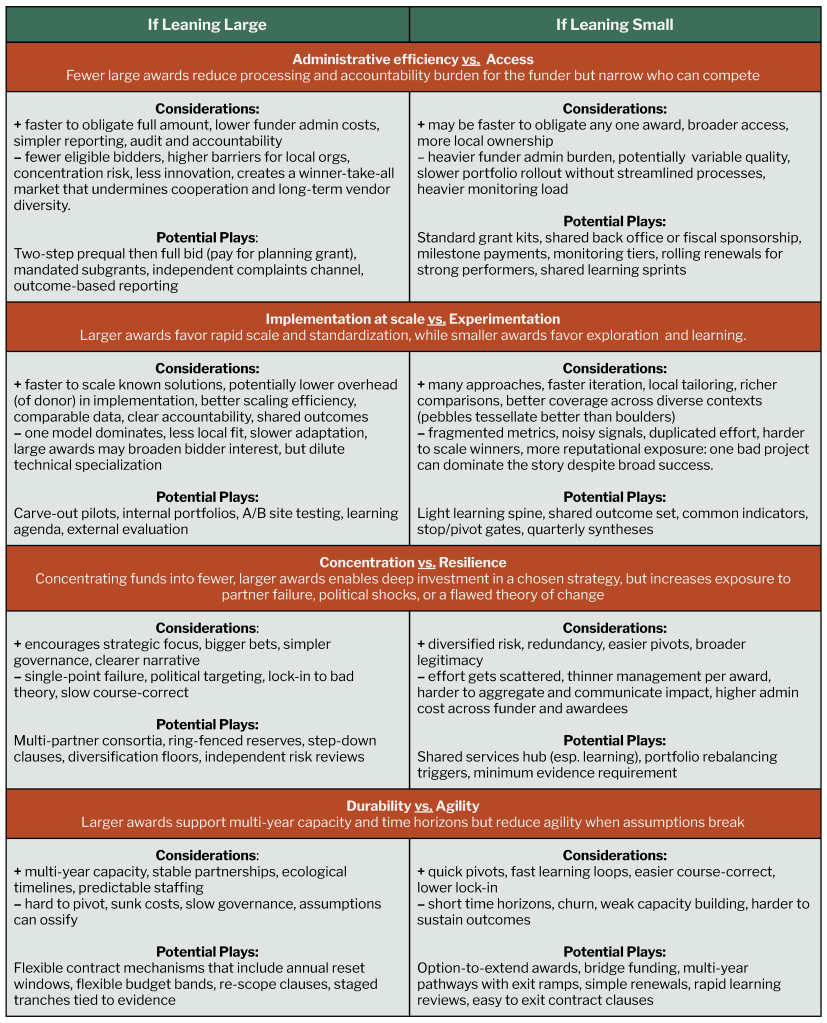
Award-size decisions play out across four dimensions. For each dimension, the table shows what to watch for if you lean toward larger awards (left) or smaller awards (right), including key considerations and practical “plays” you can use to capture the upside and reduce the downsides.
Help us Build the Playbook
Comment on this post or add to the discussion on LinkedIn with these questions in mind:
- If you were designing a new USG conservation portfolio from scratch, what mix of implementation level award sizes would you start with—and why?
- What’s one design move (on-ramps, cohort models, continuation gates, etc.) that you’ve seen actually work to mitigate award-size trade-offs?
- What’s an example of a large award that worked? What conditions made it succeed? What’s an example of a large award that failed—and what derailed it?
- Have you seen a portfolio of small awards outperform a large program? What coordination or shared learning made that possible?

Learn More
Additional resources relevant to this topic. Please feel free to suggest more for us to add to the list.
“The Big Bet Bummer” (Kevin Starr, Mulago Foundation)
- The Resource: The Big Bet Bummer by Kevin Star (Stanford Social Innovation Review).
- Description: An analysis of the trend toward massive, multi-million dollar grants in philanthropy. Starr argues that “big bets” often prioritize funder convenience over organizational health, forcing partners to scale faster than their absorptive capacity allows.
- Relevance to Award Size: This directly addresses the Concentration vs. Resilience trade-off. It provides a cautionary framework for how large awards can inadvertently “de-risk” the funder while “re-risking” the partner, creating “too big to fail” dynamics that lead to catastrophic failure if the single theory of change proves flawed.
“Making Big Bets for Social Change” (The Bridgespan Group)
- The Resource: Making Big Bets for Social Change (Stanford Social Innovation Review).
- Description: The strategic case for capital aggregation. This research suggests that social change is often stifled by fragmented, “peanut-butter-spread” funding that lacks the critical mass to solve complex, systemic problems.
- Relevance to Award Size: This resource articulates the Coherence side of the trade-offs. It explains why a portfolio might lean toward larger awards to achieve “unified metrics” and “strategic focus,” arguing that significant capital is a prerequisite for tackling landscape-scale conservation challenges.
The Future Delivery Problem” (Center for Global Development)
- The Resource: The Future Delivery Problem Facing US Foreign Assistance (CGD).
- Description: An empirical look at USG procurement trends, documenting how the pressure to move large volumes of capital with limited staff (burn rates) forces a default to massive awards for a few large contractors.
- Relevance to Award Size: This provides the evidence base for the Administrative Efficiency vs. Access dimension. It documents the “transaction costs” that drive the system toward consolidation and explains why small awards—despite their strategic value for local actors—are often sidelined by internal agency constraints.
The CLA Toolkit (USAID Learning Lab)
- The Resource: Collaborating, Learning, and Adapting (CLA) Framework and Toolkit.
- Description: A set of operational tools designed to integrate adaptive management into the program cycle. It focuses on how to build “pause and reflect” points, evidence-based pivoting, and flexible implementation into federal contracts.
- Relevance to Award Size: This is the primary resource for the Durability vs. Agility dimension. It offers the “Moves” necessary to partially mitigate some of the risks of large awards—such as “scheduling adaptive management decision points”—to ensure that long-term funding doesn’t result in “sunk-cost lock-in” when conditions on the ground change.
Resolving the SLOSS Dilemma
- The Resource: Resoliving the SLOSS Dilemma
- Description: A foundational ecological theory examining whether biodiversity is better protected by a single large (SL) habitat reserve or several small (SS) ones of equal total area. It highlights how variables like connectivity, edge effects, and species heterogeneity determine the “correct” spatial strategy.
- Relevance to Award Size: This provides the scientific basis for moving away from “universal rules” of funding. It illustrates that “bigger isn’t always better”—specifically showing that while large investments protect against extinction events (resilience), smaller, diverse investments often capture higher total innovation and variety (heterogeneity).



 Reimagining Conservation
Leave a comment