
Developed by Shawn Peabody, Nick Salafsky, Robin Martino and the Reimagining Team.
The Reimagining Issue Series
This brief is part of a series produced by Reimagining Global Conservation to support a bipartisan Playbook for reimagining the U.S. role in global conservation. The series will inform a future U.S. re-engagement after the 2025 disruption of U.S. foreign assistance. Each paper frames a decision the rebuilt system must make, lays out trade-offs, and poses questions for discussion and debate.

At a Glance: Intermediaries are entities that connect conservation funders to conservation implementers. How they are structured and function determines who holds power in the system, how risk is managed, and whether outcomes build long-term local capacity or reinforce dependency. At their best, intermediaries can expand the pool of implementers, strengthen accountability, aggregate capital, coordinate learning, build capacity, and scale programs. But they can also usurp decision-making authority, increase administrative burden, siphon off scarce resources, and shape programming around compliance or fundraising rather than ecological or community priorities. In a reimagined conservation sector, there will undoubtedly be a need for intermediaries. What can we learn from past experience that might guide which intermediary functions are critical, what structures best enable these functions, and what trade-offs are we willing to make?
What is an intermediary?
An intermediary is any entity that connects funders to implementers rather than providing funding or delivering programming entirely on its own. Many intermediaries directly manage public or philanthropic funds and then channel or regrant those resources to others. Intermediaries can also help implementers access funding sources directly and provide capacity-building support and other wraparound services. In some cases, an entity can simultaneously implement a strategy and serve as an intermediary by contracting other local organizations to help implement specific parts of the strategy. Intermediaries are non-governmental organizations, private contractors, faith-based organizations, universities, regranting platforms or funds, fiscal sponsors, marketplace or platform actors, regional or local umbrella organizations, national ministries, protected-area agencies, and public conservation funds.
Historically, many U.S. federal agencies were not structured to implement programs directly, and therefore relied extensively on intermediaries to help carry out international conservation work. A future U.S. role in international conservation will require a set of core functions to be performed somewhere in the system. The design challenge, addressed in the trade-offs section below, is deciding which entities should perform which functions and how those entities should relate to one another.
Why this matters now
In 2025, the foreign assistance freeze and program terminations disrupted U.S.-funded international conservation across agencies, including U.S. Agency for International Development (USAID) programs, and U.S. Fish and Wildlife Service (USFWS) and U.S. Forest Service international grants. International conservation retains cross-party appeal, so some form of U.S. government reengagement in this space is likely, but how that system will be rebuilt remains a question.
Early choices about delivery mechanisms will shape who can access funding, how risk is managed, where accountability runs, and whether the next system rebuilds old bottlenecks or creates better pathways for conservation outcomes. If intermediary design defaults to administrative convenience or political optics, familiar problems will take hold again.
What we learned from the pre-2025 era
Several patterns from the period are especially relevant for a rebuilt U.S. conservation portfolio. They show how different delivery structures were used in practice, why they were attractive, and what trade-offs they created when functions were bundled in different ways.
USAID’s programing by 2025 typically included some larger awards to intermediaries, often with smaller local awards to local organizations. Staff designed awards this way for reasons rooted in operational realities: tight staffing made larger awards more manageable than many small ones, and local organizations often could not meet pre- and post-award compliance requirements. But this approach also meant that substantial fractions of the funds went to the intermediaries rather than the end implementers.
With the move toward localization, Missions were testing awards designed for local organizations, such as USAID/Tanzania’s Hope Through Action activity, restricted to local NGOs, and USAID/Madagascar’s conservation program, which set aside $2 million exclusively for a local Malagasy entity. These awards improved direct access to funding but still required stringent compliance and pre-award risk assessments, capacities built through years of prior donor investment. Localization shifted the steep overhead costs of compliance rather than eliminating them. After the 2025 cancellations, it is unclear whether that hard-won compliance infrastructure survives or whether local organizations would want to rebuild it.
Bilateral and multi-lateral aid funds were also often channeled through host governments, including environmental ministries, protected-area agencies, subnational governments, and public conservation funds. These approaches could align conservation funding with sovereign authority, laws, budgets, and enforcement systems. They can appear newly attractive in rebuilding moments because they offer scale and public legitimacy, but they carry familiar governance risks when public financial management, procurement, political accountability, or civil society participation are weak.
Local umbrella organizations served as intermediaries to empower community organizations at a regional scale and influence. For example, the Community Wildlife Management Areas Consortium in Tanzania helped federated community-based organizations with representation, technical services, commercial intermediation, and policy advocacy. These models worked best when they were accountable to constituent organizations, performed clearly bounded functions, and strengthened local tenure or governance rather than substituting for it.
Some government agencies, such as the U.S. Fish and Wildlife Service’s International Affairs program, made direct grants to implementing organizations with less reliance on large intermediaries. These awards created a more direct pathway for funding conservation organizations, often with lighter reporting and repeat support that built strong partnerships but sometimes dependence. They also tended to be smaller and were still relatively administratively demanding for both USFWS and recipients. While many awards were competed, these funding opportunities were not always widely visible beyond organizations already connected to USFWS networks.
The trade-offs that matter
The history above describes why each delivery pattern emerged and where it strained. This section turns from explanation to design: which functions a rebuilt system must cover, and which delivery models can hold them. Every delivery model solves some problems while creating others; the work is matching functions to context. Past systems often bundled functions in ways that hid trade-offs, asking one intermediary to enforce donor rules against the partners it was meant to champion, or to choose the winners it had also coached. Bundling conflicting roles without acknowledging the tension can cost an intermediary the trust of local partners while still failing to give funders reliable learning or accountability. A rebuilt system should ask which functions need to be performed, who is best positioned to hold them, and what incentives that choice creates.
At least eight core functions are required:
- Public accountability and risk control
- Award and sub-award decisions
- Money movement and award administration
- Government engagement and policy alignment
- Technical quality, implementation, and capacity support
- Learning, evidence, and adaptation
- Long-term finance and financial structuring
- Coordination, shared infrastructure, and collective power
These functions do not all need to sit in the same entity. But every necessary function needs an owner, and every added layer should solve a real problem. Each choice shifts risk, power, incentives, and burden among funders, intermediaries, governments, and local actors. The table below compares several delivery models and the trade-offs they tend to create.
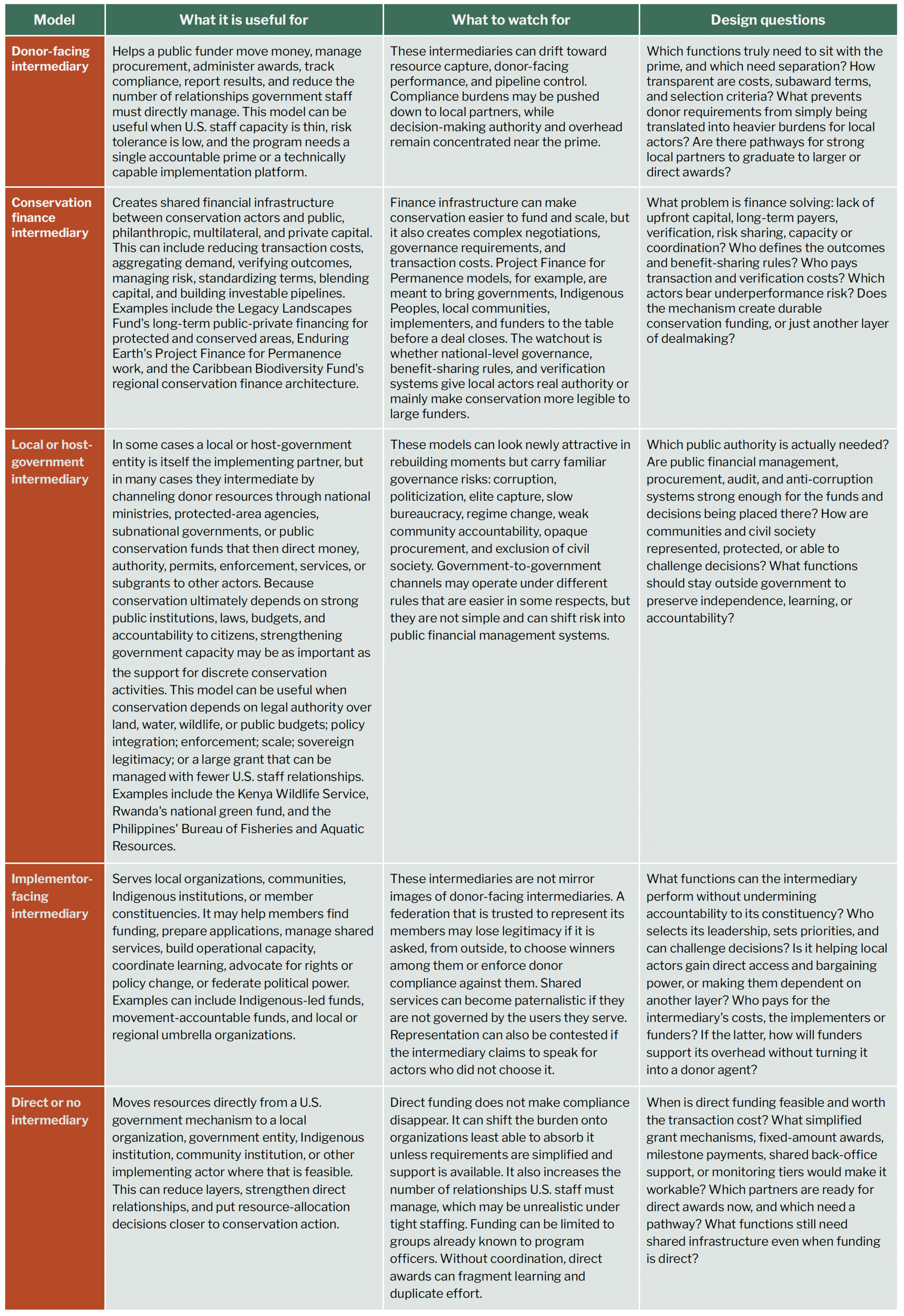
Several implications follow from this frame. First, “intermediary” is too broad to be a useful category on its own. Intermediaries perform many different functions, from managing donor compliance and channeling funding to strengthening local organizations, representing community interests, or connecting investors with conservation opportunities. Each function presents different benefits, risks, and accountability challenges.
Second, donor-facing and implementor-facing intermediaries are not symmetrical. Donor-facing intermediaries may be well-placed to administer awards, screen risk, and aggregate reporting. Implementor-facing intermediaries may be better placed to build local capability, coordinate member priorities, and help implementers approach funders. Asking one kind of intermediary to perform the other’s role can create contradictions.
Third, government-linked intermediaries are different from other intermediaries. They are important because conservation depends on governance systems that establish and enforce laws, guide land-use planning, issue permits, enforce regulations, or align public budgets with conservation goals. Working through government institutions can strengthen the systems ultimately responsible for long-term stewardship. However, alignment with government priorities does not necessarily mean accountability to local communities. These models work best when they are accompanied by transparent decision-making, meaningful civil society participation, and safeguards that ensure communities have a voice and are protected from exclusion or political capture.
Fourth, conservation finance intermediaries deserve attention, but they should not be confused with full conservation delivery systems. They can help align public, philanthropic, multilateral, and private capital; standardize terms and verification; reduce transaction costs; and build investable pipelines. But these models still need clear governance, safeguards against finance-driven selection, and ways to ensure that local actors retain authority over the work.
Finally, all intermediary models face a gravitational pull toward the funder. Money, reporting, reputational incentives, and renewal pressure tend to make organizations more attentive to donors over time. A better design does not assume good intentions will solve this. It builds in counterweights: transparent costs, clear functions, local governance, independent feedback, proportionate compliance, pathways to direct funding, and measures of success that track whether local conservation capacity and authority actually grow.
Help us Build the Playbook
Comment on this post or add to the discussion on LinkedIn with these questions in mind:
- What examples demonstrate intermediaries successfully building local capacity, governance, and long-term access to funding?
- What examples demonstrate intermediaries creating bottlenecks, concentrating power, increasing administrative burdens, or weakening local accountability?
- What safeguards and accountability mechanisms are needed to ensure intermediary models strengthen conservation outcomes while supporting local leadership and public trust?
- How might we understand and predict interactions between intermediary types in the same system?
- When does spreading the work across several organizations actually pay off, and when does an added layer just bring cost, delay, and finger-pointing?
- Which intermediaries have won the confidence of their funders and the communities they serve at the same time, and how did they do it?

Photo: Gregoire Dubois
Learn More
Additional resources relevant to this topic. Please feel free to suggest more for us to add to the list.
Reimagining Intermediaries: Shifting Power Dynamics in Conservation Funding (Maliasili & IUCN)
- Description: Examines how conservation funding intermediaries influence power, accountability, and decision-making, with particular attention to local umbrella organizations and funding architecture.
- Relevance to Intermediaries: Provides relevant conservation-specific framework for understanding intermediary design, including when intermediaries strengthen local leadership and when they risk concentrating power.
- Description: Presents findings from grantee experiences with intermediary funders, exploring both the benefits and challenges of intermediary-led funding models.
- Relevance to Intermediaries: Highlights how intermediaries can expand access to funding and support smaller organizations while also creating additional layers of bureaucracy, reporting requirements, and accountability.
- Description: Analyzes whether intermediary organizations contribute to more equitable conservation outcomes and environmental justice.
- Relevance to Intermediaries: Demonstrates that intermediaries do not automatically advance equity; outcomes depend on whether they intentionally shift decision-making authority, resources, and recognition to local communities.
Power and the Changing Role of Intermediaries (Tom David)
- Description: Explores the evolving role of intermediaries in philanthropy and social change efforts, focusing on questions of governance and power.
- Relevance to Intermediaries: Provides a useful conceptual lens for understanding intermediaries as governance infrastructure that can either concentrate control or redistribute power to frontline actors.
How Movement-Accountable Intermediaries Can Change Philanthropy (Sonya Childress)
- Description: Describes intermediary models that are governed by and accountable to the movements and communities they support.
- Relevance to Intermediaries: Offers a practical example of implementor accountability, illustrating how intermediary structures can be designed to strengthen community leadership rather than donor control.
Is the regranting boom outrunning accountability? (Adam Miller, Inside Philanthropy)
- Description: Argues that the growth of conservation regranting and intermediary funding needs stronger accountability tests, transparency, and attention to whether intermediaries are paying down or reproducing the “legibility tax” imposed by donors.
- Relevance to Intermediaries: Offers a practitioner view from Planet Indonesia on when regrantors absorb donor compliance burdens for local partners and when the same architecture can obscure whether power is shifting or consolidating.
Working with Intermediaries Strategically (Robert Wood Johnson Foundation)
- Description: Provides guidance for funders on the strategic use of intermediaries, drawing on research and practitioner experience.
- Relevance to Intermediaries: Provides the closest general taxonomy for this paper’s design question: when intermediaries add value, what functions they should perform, and how funders can structure those relationships to support stronger outcomes and community power.
Intermediary NGOs: The Supporting Link in Grassroots Development (Thomas F. Carroll)
- Description: The foundational study of organizations that act between donors and grassroots communities, distinguishing grassroots support organizations from membership support organizations.
- Relevance to Intermediaries: Establishes the implementor-facing intermediary as a distinct organizational type with its own basis of legitimacy, and grounds the distinction between donor-facing and implementor-facing intermediaries.
Governing by Network: The New Shape of the Public Sector (Stephen Goldsmith & William D. Eggers)
- Description: Argues that government increasingly achieves public goals by orchestrating networks of public, private, and nonprofit actors rather than delivering services directly, and examines the accountability challenges this creates.
- Relevance to Intermediaries: Provides the public-administration basis for a U.S. role that holds accountability and policy functions while assigning delivery and finance elsewhere, and the discipline that every networked function still needs a clear owner.
Greening the Grassroots: Rethinking African Conservation Funding (Maliasili & Synchronicity Earth)
- Description: Draws on interviews with around 50 African local and grassroots organizations and their funders to document how conservation funding is structured and what would get more of the right funding to local actors.
- Relevance to Intermediaries: Grounds the paper’s design-for-local-capacity orientation in conservation-sector evidence, showing how complex donor rules and reporting requirements shut out smaller organizations and how simpler, fairer finance would increase impact.



Leave a comment