
How future U.S. Government conservation programming can reduce illicit activities and transnational organized crime, strengthen legitimate governance, and protect biodiversity and communities.
Developed by Robin Martino, Anusree Garg, Lauren Risi, and the Reimagining Team.
The Reimagining Issue Series
This brief is part of a series produced by Reimagining Global Conservation to support a bipartisan Playbook for reimagining the U.S. role in global conservation. The series will inform a future U.S. re-engagement after the 2025 disruption of U.S. foreign assistance. Each paper frames a decision the rebuilt system must make, lays out trade-offs, and poses questions for discussion and debate.

At a Glance: Nature crimes are a major illicit economy that provides fuel and financing for transnational organized crime, to the tune of hundreds of billions of dollars annually. They are also accelerating biodiversity loss while undermining governance and legitimate revenue streams from natural resources and threatening communities and regional security. This brief examines what past U.S. Government efforts reveal about the need to connect locally grounded prevention with enforcement, financial disruption, demand reduction, and cross-border cooperation. It identifies the key trade-offs future U.S. programming must navigate to build a coherent response that advances security while protecting biodiversity, rights, and locally defined priorities.
What are nature crimes and why do they matter?
Nature crimes are illegal activities that exploit or damage natural resources and ecosystems and are some of the most profitable forms of transnational criminal activity (WWF). Generating billions of dollars every year for transnational criminal groups, they include wildlife trafficking, illegal fishing, illegal logging and illegal mining and the resulting habitat conversion. These offenses can occur from extraction through transport, processing, and sale, and often converge with corruption, fraud, money laundering, human-rights abuses, and other forms of organized crime. Their impacts extend well beyond the loss of individual species; nature crimes accelerate biodiversity loss, degrade ecosystems, deprive governments and communities of resources and revenue, and weaken governance and the rule of law.
These illicit activities become global security threats when their profits, networks, and methods reinforce broader criminal economies. Operation SANDOKAN, for example, documented wildlife-trafficking networks in Cambodia that operate internationally, engage simultaneously in drug and timber trafficking and human exploitation, and rely on protection from political and business elites. In the Gulf of Mexico, the U.S. Treasury Department, in 2024 sanctions against Gulf Cartel members found they earned millions of dollars from illegal fishing while using the same vessels and operational networks to traffic drugs and smuggle people across the U.S. border. These cases demonstrate that nature crimes are rarely isolated criminal offenses: they are often embedded in broader criminal economies that allow powerful networks to expand their influence, compromise public institutions, and evade accountability. The resulting harms extend well beyond biodiversity loss, threatening economic stability, community safety, public trust, and national and regional security.
The urgency of addressing nature crimes as a connected conservation, governance, and security challenge has increased as recent changes to U.S. foreign assistance have disrupted many of the preventive and system-strengthening functions on which an effective response depends. Yet these threats are not insurmountable; past U.S. investments in partnerships, capacity building, and diplomacy helped strengthen political will and coordinate action, significantly impeding criminal networks, and protecting biodiversity. These gains demonstrated the potential of sustained U.S. engagement to help turn the tide against nature crimes.
What we’ve learned
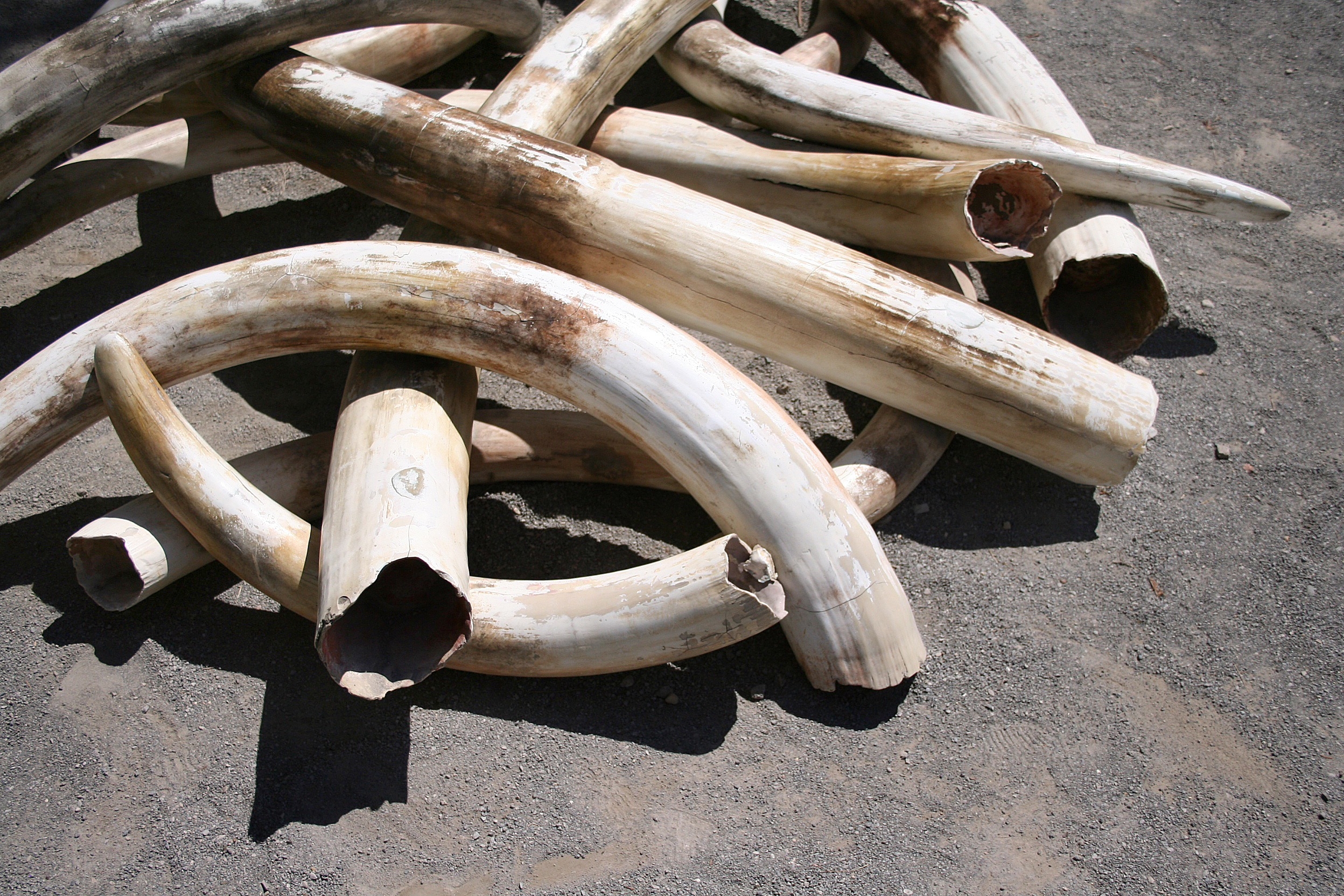
Nature crimes remain a large, profitable, and rapidly evolving threat. A 2025 World Resources Institute analysis estimates that illegal logging, mining, fishing, forest conversion, and wildlife trade generate as much as $280 billion in criminal proceeds annually, with illegal logging alone accounting for an estimated 15–30 percent of global timber trade and up to $152 billion USD each year. Although concealed activity and laundering through legal supply chains make these estimates imprecise, they reveal a major illicit economy that sustains transnational criminal networks, corruption, and environmental destruction. Its scale, impacts, and profits also fluctuate as political leadership, enforcement priorities, and donor investment change, and criminal networks adapt their routes, markets, and methods. Annual estimates therefore indicate the broad scale of this economy rather than consistent yearly earnings.
Recent rhino-horn trafficking patterns described in a Wildlife Justice Commission Report illustrate these shifts. After major investigations and arrests disrupted several rhino-horn networks in 2022 and 2023, the volume of significant rhino-horn seizures as of September 2025 had more than tripled compared with 2024. The Wildlife Justice Commission cautions that the increase—although still below 2021–2022 levels—may indicate that criminal networks are regaining confidence, investing in larger consignments, and accepting greater financial risks. Operation Thunder 2025 similarly produced a record 4,640 seizures across 134 countries, including nearly 30,000 live animals, more than 30 tons of CITES-listed species, and tens of thousands of cubic meters of illegally logged timber. Seizure totals are an imperfect measure because they also reflect the intensity and effectiveness of enforcement. Nevertheless, the scale and diversity of the goods intercepted, and the identification of more than 1,100 suspects, underscore the extensive reach and persistence of these illicit activities.
Effective responses must address the full chain of nature crimes without treating every actor as equally responsible or strategically important. Preventing poaching and other illegal extraction remains essential, particularly where immediate pressure threatens species, ecosystems, and communities. Local efforts to curtail illegal wildlife trafficking is critically important, but concentrating enforcement primarily on lower-level actors rarely disrupts the markets that drive these activities. Lasting progress also requires targeting the middlemen and networks that connect extraction to transport, processing, financing, and sale. Criminal network analysis and intelligence feedback loops, capabilities that have been strengthened through U.S. investment, help identify these connections and guide subsequent action.
Action at different levels requires distinct but coordinated approaches. At the local level, enforcement needs to be paired with stronger rule of law, attention to corruption, community trust and capacity, and viable legal livelihoods. Further along the supply chain, specialized law-enforcement, financial, regulatory, and diplomatic institutions are needed to investigate and disrupt higher-level actors. Conservation and development programs can complement these functions through governance, community support, demand reduction and coordination. Historically, the U.S. government has worked across its own agencies and with international and national institutions to support an often effective and coordinated response along the nature-crime chain, from source areas through transit routes to consumer markets. Accountability to the U.S. as a donor reinforced transparency and attention to corruption and human rights alongside enforcement results.
Much of that coordinated response was terminated and fragmented as U.S. support contracted in 2025, particularly with the loss of critical programs that complement operational enforcement action. A future U.S. Government platform could help restore integrated functions that enable more effective enforcement, including: supporting community rights and viable livelihoods, strengthening governance and institutional capacity, addressing corruption, reducing demand, and sustaining intelligence, evidence, and learning. These investments would connect locally grounded prevention with national and international investigations while reinforcing the partnerships and accountability that support effective enforcement.
A security framing could attract additional attention, resources, and capabilities and help integrate nature crimes into broader law-enforcement priorities, reducing reliance on isolated, under-resourced teams. But it could also direct funding toward countries, commodities, and networks of immediate strategic concern rather than ecosystems and communities facing the greatest biodiversity losses. A future approach should manage this tension explicitly, ensuring that security objectives reinforce biodiversity conservation and locally defined priorities. Stronger investigative and judicial systems, cross-border cooperation, and private-sector partnerships can connect these priorities with efforts to interrupt the transport and financing that make nature crimes profitable.

The trade-offs that matter
The immediate questions are which functions are critical, where they should sit, and what will be lost if funding migrates into narrower conservation or security channels. A protected-area investment can secure an important landscape, address anti-corruption issues within protected area authorities, coordinate and support community relationships and conservation actions, but miss the trafficking routes, higher-level corruption among government agencies, consumer demand, online markets, and financial flows that sit beyond its boundaries. A security program can investigate and prosecute networks but neglect the local legitimacy, livelihoods, and ecological monitoring needed to prevent crime and sustain results. The examples below describe some of the interrelated trade-offs that future programming should consider, not as either-or choices, but as tensions to be balanced across a coherent portfolio. Across these tradeoffs, the core questions remain, which functions are critical, where they should sit, and what will be lost if funding migrates into narrower conservation or security channels.
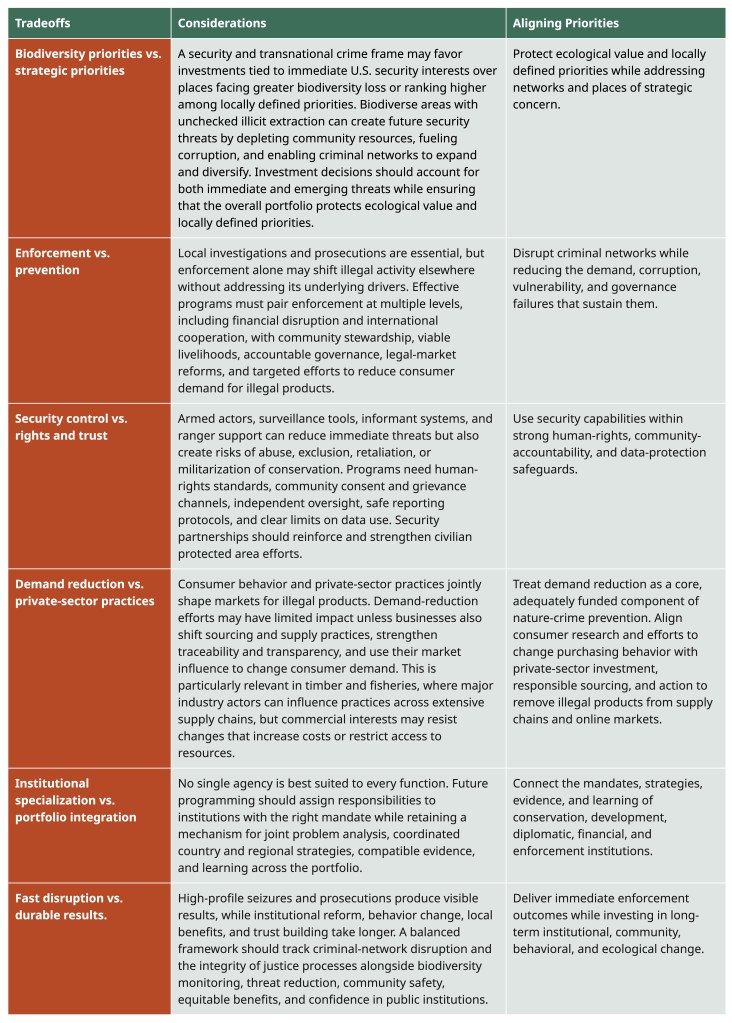
U.S. agencies and their partners continue to investigate, prosecute, and disrupt nature crimes through financial, diplomatic, and cross-border cooperation. However, the loss of USAID and other USG investment has weakened complementary functions, including community engagement, anti-corruption, rule-of-law support, demand reduction, and institutional coordination across the response. A future U.S. approach should restore these connections so that continuing enforcement efforts also advance biodiversity, rights, and locally defined priorities. The design challenge will be how to establish complementary strategies, coordination mechanisms, and accountability needed to ensure that specialized contributions operate as a coherent system while advancing security, biodiversity, and locally identified governance objectives.
Help us Build the Playbook
Comment on this post or add to the discussion on LinkedIn with these questions in mind:
- How will success be measured beyond arrests and seizures to include durable ecological, institutional, and community outcomes?
- Which functions are essential, and which institutions are best equipped to perform them?
- How will investments connect prevention in source landscapes with action across transit routes, financial systems, and consumer markets?
- How will the portfolio balance biodiversity and locally defined priorities with U.S. strategic interests?
- What coordination and accountability mechanisms will connect action across institutions and national borders?
Learn More
Additional resources relevant to this topic. Please feel free to suggest more for us to add to the list.
Nature Crime Alliance – What is Nature Crime?
Introduces five major forms of nature crime—illegal logging, mining, wildlife trade, land conversion, and crimes associated with fishing—and their connections to corruption, financial crime, and human rights abuses.
Eliminate, Neutralize, and Disrupt Wildlife Trafficking Act Strategic Review
Reviews U.S. government efforts to combat wildlife trafficking under the Eliminate, Neutralize, and Disrupt Wildlife Trafficking Act. A potentially useful reference for documenting federal agency contributions and coordination before 2025.
The Legacy of the USAID Routes Partnership
An example of USAID programming that brought together private sector, government, and conservation actors to address transnational movement of illegal wildlife and wildlife products. The ROUTES Partnership brought aviation companies, government agencies, law enforcement, and conservation organizations together to address wildlife trafficking. Describes training, data analysis, industry guidance, and enduring partnerships, providing a concrete example of USAID’s role in strengthening prevention within legal transportation systems.
USFWS Combating Wildlife Trafficking
Outlines USFWS’s role in combating wildlife trafficking through law enforcement, international cooperation, and financial and technical assistance. Connects wildlife trafficking with conservation, security, human health, and organized crime; useful for explaining the agency’s complementary enforcement and conservation functions.
WRI, People, Planet, Justice: Understanding and Countering Nature Crime (2025)
Analyzes five types of nature crime (illegal logging, mining, fishing, land conversion, and wildlife trade) and how they converge with financial crime, corruption, narcotics trafficking, and human rights abuses.
UNODC, Global Analysis on Crimes that Affect the Environment
UNODC’s flagship research series on how environmental crimes operate, who profits, and how they intersect with organized crime. The 2025 installment examines illegal gold mining and critical-minerals crime and how rising demand is fueling criminal activity.



Leave a Reply